MONITICS
The Game of Money. Choices. Consequences.
A strategy board game that mirrors real financial decisions.
How you play reveals how you think about money.
About the Game
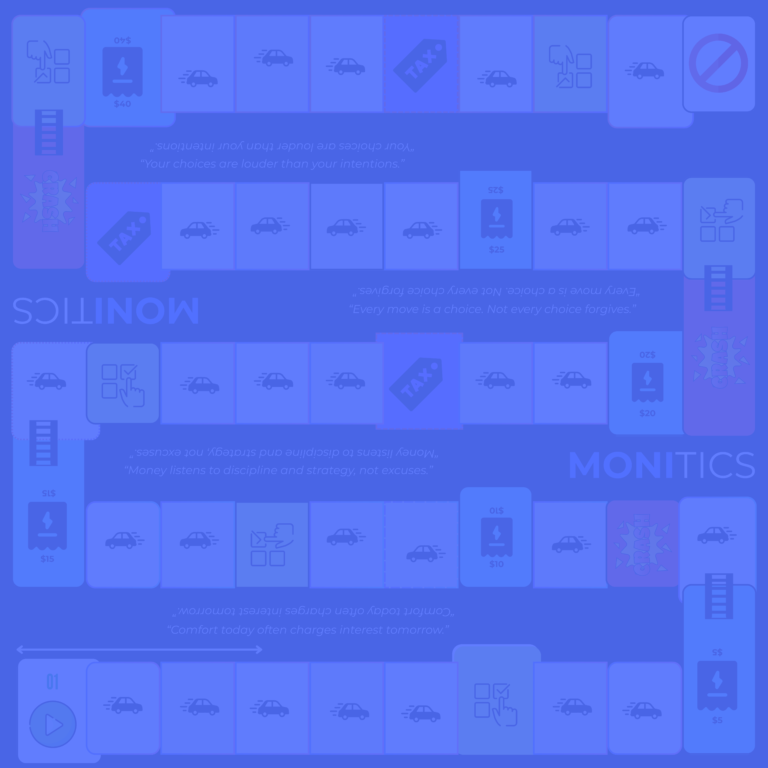
Monitics is a strategy board game about money, life decisions, and consequences. Players move across the board, earn money by trading, invest in assets, manage risks, and face unexpected events and circumstances. Every choice they make affects their outcomes. Every luck comes with a responsibility.
Money
Earn, invest, and manage your finances strategically
Decisions
Every choice creates a new path forward
Risk
Balance opportunity against potential loss
Consequences
Face the results of your financial choices
What the Game Teaches
Skills that translate from the board to real life
Financial Discipline
Learn to manage resources with intention and purpose
Risk Management
Understand when to take risks and when to protect
Long-term Thinking
See beyond immediate gains to future outcomes
Liquidity vs Ownership
Balance access to cash with building assets
Business Behavior
Experience real investment and business dynamics
Habits Shape Outcomes
Discover how patterns determine your destiny
How It Works
Simple rules, deep strategy
Roll & Move
Roll the dice and move across the board
Make Decisions
Make up to two decisions per turn (buy, sell, save, borrow)
Face Events
Land on events that test your choices
Build & Manage
Build assets, manage cash, and avoid financial traps
Win Smart
Win by making smarter decisions over time
Why MONITICS is Different
No luck without consequence
No shortcuts without risk
No reward without strategy
Every decision leaves a trace
Events & Mechanics
The 4 forces that shape Monitics game
Circumstances
Life and market situations that test preparedness and judgment. These events reflect real-world unpredictability.
Crash
A market collapse that forces asset liquidation at distress value. Preparation and liquidity are your only defense.
Tax
Players may pay tax voluntarily or face penalties when caught. Honesty has its costs, but so does evasion.
Bills
Regular living expenses paid upfront. These represent the unavoidable costs of existence.
Game Rules
Everything you need to start playing
Money, Capital & Payments
Each player begins with a set amount of cash. This is your foundation — use it wisely. Running out of cash limits your options significantly.
Assets & Investments
Each player begins with a set amount of cash. This is your foundation — use it wisely. Running out of cash limits your options significantly.
End of Game
Each player begins with a set amount of cash. This is your foundation — use it wisely. Running out of cash limits your options significantly.
Loans & Debts
Each player begins with a set amount of cash. This is your foundation — use it wisely. Running out of cash limits your options significantly.
Buy the game
Rules PDF
Contact us
FAQ
Questions Players ask
How many players can play MONITICS?
MONITICS works best with 2 players.
How many actions can I take on my turn?
You must take 2 actions per turn.
Actions include buying, selling, saving, taking your savings, borrowing, or repaying loans.
Can I buy and sell the same asset in one turn?
No.
An asset cannot be sold on the same turn it is bought.
Can I sell assets at any time?
Assets can only be sold on your turn, unless a card or event forces a distress sale.
What happens if I cannot pay a bill or penalty?
If you cannot pay:
You must sell an asset at distress value
Or use savings, insurance, or negotiate with another player
If you still cannot pay, you lose the game.
What is a Distress Sale? Can players buy distressed assets from each other?
A Distress Sale means selling an asset at its distress value, which is lower than normal market value. Yes.
During a distress sale, another player may buy the asset at an agreed price.
What is a Crash?
A Market Crash forces all assets to be liquidated at distress value.
Savings are not affected.
Insurance may protect one insured asset only.
How does insurance work?
Insurance protects one asset of choice against liquidation, crash or problem. The player would lose insurance to protect one asset in trouble time.
Insurance does not protect:
Cash
Savings
Taxes
Bills
Percentage cash losses
How does tax work in the game?
You may pay $25 voluntarily to get the Tax Card
If caught by the Taxman, you pay $50
Once you have the Tax Card, you are tax exempt for the rest of the game
If you cannot pay immediately, the amount becomes a liability with a $10 penalty at game end
What are Options used for?
Options give flexibility, such as:
Replaying your turn
How do we handle odd amounts like $73 or $108?
Use the Payment Rounding Rule:
Amounts ending in $1–$5 → pay $5 example: $54, $52 or $51 = $55 cash
Amounts ending in $6–$9 → pay $10 example: $56, $57 or $58 = $60 cash
Always round up.
When does the game end?
The game ends when a player reaches the final box.
Other players may take their final two turns, then net worth is calculated by subtracting liabilities from assets in order to have a networth.
Players who earn $1000 or more are considered extremely successful.