Objective of the Game
The goal of Monitics is to finish the game with the highest net worth, calculated as: Cash + Savings + Asset Value − Liabilities
Players win not by moving fastest, but by making better financial decisions and accumulating wealth in spite of the challenges that come.
Players who make up to $1000 are considered extremely successful. Each game session is considered one year of living.
How the Game Works
- Players take turns rolling a die and moving around the board.
- Each boxes represents a financial situation:
- Bills
- Assets
- Circumstances (Life & Market events)
- Tax authority
- Crash (market crash)
- On each turn, players must make up to two actions (within two minutes):
- Buy
- Sell
- Save
- Borrow (if eligible)
- Certain boxes force actions or penalties.
- The game progresses until a player completes the board by reaching the last box.
Final net worth is calculated to determine the winner. Any player who earns a thousand dollars or more has done well.
Turn Structure
On your turn:
- Roll the die
- Move forward
- Resolve the box you land on
- Make up to two actions (like buy + sell, save + borrow/repay or buy + save)
- End your turn
You may not exceed two actions unless explicitly allowed by a card or rule.
CIRCUMSTANCES
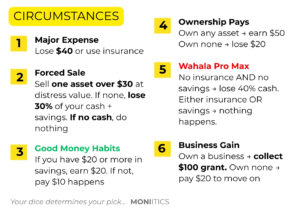 Circumstances: Life & Market Cards
Life happens. Good, bad, and inconvenient.
When a player lands on a Circumstances space, the number rolled that landed them to the box determines the situation they face and the financial consequence that follows.
These events test preparation, ownership, and discipline—exactly the things real money cares about.
1. Major Expense
An unexpected cost hits.
- The player must lose $40, OR
Use insurance (if owned) to avoid the loss entirely.
2. Forced Sale
You are forced to raise cash under pressure.
- Sell one asset worth over $30 at distress value, OR
- If no such asset exists, lose 30% of your cash and savings combined
If the player has no cash or savings at all, nothing happens
3. Good Money Habits
Your discipline pays off.
- If you have $20 or more in savings, earn $20
If not, pay $10
4. Ownership Pays
Ownership finally flexes.
- If you own any asset, earn $50
If you own nothing, lose $20
5. Wahala Pro Max
This is financial chaos at full volume.
- If you have NO insurance AND NO savings, lose 40% of your cash
If you have either insurance OR savings, nothing happens
6. Business Gain
Entrepreneurship shows its teeth.
- If you own a business, collect a $100 grant
If you own no business, pay $20 to move on
Important Note
- All Circumstances effects are mandatory
- Players must resolve the event before ending their turn
- If a player cannot fully pay a penalty, standard Monitics insolvency rules apply
When a player lands on a Circumstances space, the same dice number that moved the player onto that space automatically determines the Circumstances outcome.
The player does not roll again
The dice number corresponds directly to the numbered Circumstances list (1–6)
The player must resolve only the Circumstance matching that number
Example:
If a player rolls a 4 and lands on a Circumstances space, the player must resolve Circumstance #4 – Ownership Pays.
Saving
- Saving or breaking a saving are both considered as moves. i.e. if you decide to take your savings, that’s one move. Same if you decide to save.
- Players may move money from cash into Savings as long as they have an active turn.
- Cash in savings is not affected by cash liquidities.
- Savings do not earn interest automatically
Buying Assets
Players may purchase:
- Properties
- Stocks
- Companies
- Commodities
- Leverage: option and insurance
Each asset has:
- Purchase value
- Market (sell) value
Distress value (used during forced sales or Crash)
Selling Assets
- Assets may be sold only on your turn
- Assets cannot be sold on the same turn they are purchased
- Market conditions, Circumstances, or Crash may force distress sales
Loans
Players may take one loan at a time. Loans are progressive – a player must borrow and return the $200 and then $300 before $500
Loan types:
- Small Loan: Borrow $200 → Repay $240
- Medium Loan: Borrow $300 → Repay $350
- Big Loan: Borrow $500 → Repay $600
- Players must take loans incrementally i.e. one must borrow and return a $200 loan before they can take the next higher one.
- Loans must be fully repaid before taking another
- You cannot borrow and repay a loan in the same turn
The loan cards (AKA loan contract) should be kept in the players “liabilities box” until repaid
OPTIONS
Options provide flexibility.
Available options:
- Replay your turn – after a dice is rolled, roll again. The player would work with the last option according to the last dice.
Rules:
- Players may buy options from other players if options are scarce.
Insurance
Insurance can protect players from:
- Major expenses
- Forced sales
- Asset loss
- Crash events
- Insurance is returned to the bank after use.
- When insurance is used, the player cannot make any other move until the next turn.
- Players may buy insurance from the bank or from another player (if willing)
Bills
Bills represent everyday living costs:
- Rent
- Food
- Transport
- Utilities
Rules:
- Bills must be paid immediately
- Bills are paid upfront—no cards
- Bills cannot be carried over
- Bills may be paid from cash, loans or savings – when a player cannot afford to pay a bill, they lose, the game ends. However, another player may lend the other a loan to help them offset bills so they can continue playing.
Tax Authority
- Voluntary Tax: A player may choose to pay $25 at any time on their turn to become tax compliant and avoid penalties.
- Tax Penalty: Ignoring tax may result in being caught by the Taxman and paying $50.
- Immediate Effect: When tax is paid (voluntarily or when caught), the player receives a Tax Card and becomes tax exempt for the rest of the game.
If a player cannot pay immediately when caught, the amount becomes a liability and must be paid at the end of the game with an additional $10 penalty.
Crash (Market Crash)
When Crash occurs:
- All assets must be sold at distress value. If no assets, lose 60% of unsaved cash value.
- Savings are not affected by the crash.
- Insurance or 2 options may prevent Crash
Crash represents major financial disruption—job loss, business failure, or economic shock. A market crash is a sudden, rapid, and often unexpected drop in asset prices.
Distress Sales
Forced sales use the asset’s distress value
Distress value may result in:
- Loss
- Break-even
- Reduced gain (depending on asset type)
Player-to-Player Distress Purchases
- Another player may buy a distressed asset at an agreed price
- The selling player must accept the offer
- Distressed assets cannot be resold immediately until the second turn.
PLAYER INTERACTION RULES
PLAYER INTERACTION RULES
- Players may negotiate during distress sales
- Players may buy insurance or options from other players (seller must agree)
- Only one such transaction is allowed per turn
- All agreements must be completed immediately
End of the Game
When a player completes the board, they may give the other player two final turns to end the game and calculate their net worth. The player may or may not accept to use the turns.
Each player calculates:
- Total cash
- Total savings
- Total asset value
- Minus outstanding liabilities
The player with the highest net worth wins.